Показаны сообщения с ярлыком car tech. Показать все сообщения

Peugeot 908 HDi FAP Hybrid Racer Debuts, Fails To Charge Audience


Photo Source: Motor Dude

Recently, Peugeot unveiled their new green Le Mans contender, the Peugeot 908 HDi FAP Hybrid Racer. Although heralded as a major achievement in the racing industry and praised for its environmental progressiveness, I am not enthused. If an automobile doesn’t translate into a real world application, like the Peugeot 908 hybrid racer largely fails to do, then I’m just not interested. To be perfectly honest, I think dropping that kind of cash to engineer a top performance race car that stores any unused kinetic energy is a waste. When was the last time a Formula 1 racer interrupted his crew chief by saying, “Well yes Hank, 0-60mph in under 3 seconds is very impressive, but what kind of gas mileage does it get?”

I’ll hand it to Peugeot though, the design department did a hell of a job creating an aesthetic for the 908 HDi that was both sleeking and imposing, in an impending-alien-probe sort of way. Bottom line: if this were street legal, I’d be all over it, but as it stands, it doesn’t seem particularly exciting.


Related posts:


Related posts:


Top 5 Geek Gadgets for Your Car

So you’re a geek and you want some geek gadgets? I’m with you mang. Too long I’ve hidden my science and electronic loving ways. It’s time I wore my geek-itude on my sleeve, like some kind of sleeve based pocket protector for a pocket that’s on my sleeve. Right?

Whatever, here are the top five awesome whiz-bangs 4 your car:

1. 400 Watt Power Dome Mini Generator

Every car should have a jumpbox - a battery box that lets you jumpstart your car even if no one is around. That’s what this is, a 600 cranking amp jumpbox, in addition to a bunch of other things.

It has 2 AC outlets and 2 DC outlets, a 400 watt inverter, with a level indicator, AND, the best part… a built-in 275 psi air compressor.

2. Digital Wi-Fi Detector

Autonet mobile is supposedly coming out with always on wi-fi for your car. If so, I can wait for that to come out, shell out $399 up-front and 50 bucks a month for their untested service. Or I can pay 50 bucks once for the ability to find free wi-fi as I drive. Easy choice.

Your typical WiFi detector will only show you if the signal is there, and it’s relative strength. Not that helpful. This Digital WiFi Detector has a backlit LCD screen that provides information on signal availability and strength as well as network information, like SSID, security status and channel. When multiple networks are present, the LCD will allow you to scroll through information for each network.

3. Mini Fridge/Warmer - For Your Car

It’s a fridge AND warmer for your car, you shouldn’t need convincing.
It has a 20 liter capacity and a digital LCD display with the current inside temperature. It goes down to 44 degrees Fahrenheit and warms up to 140 degrees. Come on. Awesome

4. Automotive ECM Scanner

Getting your car’s brain scanned and reset at an automotive shop usually costs a few hundered dollars. Now you can do it yourself. Most people don’t realize, theres a plug on your car’s ECM/ECU computer (called the “brain”) that’ll let you access that computer.

You can read engine trouble codes and can reset the “check engine” light, read all sorts of tracked data (fuel economy, battery voltage, coolant temp., etc.). You can even start to get involved in the whole engine ECM turner subculture.

Pretty cool stuff that used to be only available to diagnostic and repair shops.

5. Smart AC 120 USB Power Inverter

I’m always in need of converters in my car. With this gadget, I can just plug it into the cigarette lighter… then plug in any standard AC powered device. Screw all those old adapters.

300 Watt peak output, 120 Watt standard use, so that’s plenty of power for anything I’m using.

You know of any gadgets I miseed? Let me know in the comments.


Related posts:


Related posts:


The World’s Smallest Car: The Nanocar


This is NOT the World’s Smallest Car

The illustrious title of World’s Smallest Car, sought by many, but held by only one. And who is that one? No, it’s not the car above, or the Smart ForTwo, or the Tata Nano; not the obscure Waaijenberg Canta or even the Peel P50, no matter what the Guinness Book of World Records says. Those cars are giants compared to the real smallest car.

So what is it? Check out the REAL picture after the jump:

It’s the Rice University Nanocar, and it’s the size of a single strand of DNA. It measures just 4 x 3 nanometers (A nanometer is equal to one billionth of a meter or one millionth of a millimeter). A human hair is about 80,000 nanometers thick. But it’s not just bullshizz nonsense made up by grad students with too much time on their hands…this thing actually works like a car. It has a chassis, axles, a pivoting suspension, and the wheels are buckyballs (aka Buckminsterfullerenes, which are tiny spheres of pure carbon - named after R. Buckminster Fuller, one of the coolest dudes ever).

It’s apparently hard to make a nanoscale object roll, but they’ve done it. And why? Well, the eventual goal is the create nanoscale trucks that could carry atoms and molecules around in miniature factories. It’s one step closer to tiny autonomous self-replicating machines doing our work for us at the nano level. End of the world Grey Goo, here we come!


Related posts:


Related posts:


The Hybrid Car Glossary: RideLust’s Guide To Green

Ok, so that long-haired, soy-latte-drinking guy at your local coffee shop is always talking about how amazing his hybrid car is, and he always seems to have a snide remark for your Ford F-250 Lmtd. Ed. King Ranch. You’ve grown to really loathe the little prick, and you derive no small source of pleasure from boxing his Prius into his parking space with your giant rig.

Unfortunately, with the ever-rising cost of gas, your monthly fuel bill is dangerously close to exceeding the federal deficit, and it’s beginning to outweigh your devotion to smiting the pretentious hybrid elitists. So you’ve decided you’ve got to make a change – fast – and although you hate to admit it, you’re beginning to wonder if maybe that little hybrid-humping freak isn’t on to something. You don’t know much about alternative-fuel vehicles, and you know that he’d probably be a lot of help in navigating through the hybrid market, but you’d rather suck the tailpipe on your truck then admit defeat to him.

Well fear not, oh emperor of emissions, because we here at RideLust have taken it upon ourselves to develop of glossary of sorts for the new hybrid technologies beginning to flood the market.

To begin, let us explain that the term “Hybrid” can be used to describe any vehicle that uses two or more power sources to provide propulsion. Although technically “hybrid” can apply to any type of alternative-fuel vehicle, the hybrids most commonly seen in today’s market are Hybrid Electric Vehicles [HEV], which are powered by at least one source of electrical energy and an Internal Combustion Engine [ICE]. HEVs are often broken up into 5 primary categories based on how much the electric motor contributes to the propulsion of the vehicle. The 5 main types of hybrids are as follows:

1. Dual-Mode or 2-Mode Hybrid – The type of hybrid used by both GM and Chrysler in their most recent contributions to the hybrid SUV market, a Dual-Mode Hybrid is a hybrid vehicle that is capable of functioning in two distinct ways. In Mode 1, vehicle operation is controlled entirely by the vehicle’s electric source of energy. Often times, in a 2-Mode Hybrid system the vehicle is programmed to remain in Mode 1 until the vehicle reaches a certain rate of speed [usually somewhere between 25 – 30 mph], at which time an automatic shift to Mode 2 occurs. In Mode 2, the vehicle’s electric motor[s] and ICE operate in tandem, fluctuating the amounts of each source of power used in response to each vehicle task [i.e.: acceleration, towing, etc.].

2. Full Hybrid – A Full Hybrid vehicle is one that can be independently operated by the electric motor, the ICE, or a combination of both. Occasionally, Full Hybrid vehicles are also referred to as “Parallel Hybrids” due to the fact that the electric motor and ICE are wired to parallel the same transmission. The rate of fuel savings on Full/Parallel Hybrids is usually somewhere between 50-56%, making full hybrid vehicles among the most fuel efficient of the HEV family.

3. Micro Hybrid – In a Micro Hybrid, no driving power comes from the electric motor at all; instead, energy generated from the electric motor is used to provide power to auxiliary functions. The electric motor also acts as a starter/generator that allows the ICE to stop and restart instantly to avoid idling while simultaneously enabling regenerative braking [the automatic recharging of the vehicle’s electric power source/battery]. Occasionally, a Micro Hybrid is also referred to as a Stop/Start Hybrid.

4. Mild Hybrid – In a Mild Hybrid vehicle, the electric motor provides supplementary torque to the ICE, often using functions such as Integrated Motor Assist [IMA] and Integrated Starter Alternator with Damping [ISAD]. Like the Micro Hybrid, however, the electric motor in a Mild Hybrid is never the sole source of driving power [although confusing, Mild Hybrids can also be referred to as Start/Stop Hybrids].

5. Series Hybrid/Serial Hybrid – The term “Series Hybrid” refers to a full-electric vehicle singularly propelled by its electric motor. Although Series Hybrids do receive support from a small ICE, rather than directly propel the vehicle, the fuel-burning engine drives an alternator that generates electricity. Once generated, the electricity is then delivered to either the electric motor for power, or to a battery for storage.

Of course, the most popular Full Hybrid on the market is the Toyota Prius, but other manufacturers are playing a quick game of catch-up. Ford currently produces a Full Hybrid Escape, but if that V6 engine isn’t powerful enough for you, Dodge is releasing the Durango HEMI Dual-Mode Hybrid V8 in the fall. Cadillac is also introducing a Dual-Mode Escalade Hybrid, and several other large-vehicle models like the GMC Yukon and Chevrolet Tahoe are rapidly following suit. So there’s hope for the American SUV yet my friend, you just gotta hang in there.

Sources: [US Dept. of Energy][Green Car Congress]


Related posts:


Related posts:


GE Works to Make Heavy Hybrids Out of Mega-Movers

Mega Mover dump trucks have been used in open pit mining as a means to save money; larger trucks require fewer trips with larger loads and reduced fuel costs. As fuel prices continue to climb GE (General Electric), with additional funding from the US Department of Energy, has been working to include hybrid technology in these mega movers. As many of the huge mining trucks already have diesel generators and electric motors as their motive power adding regeneration technology and rugged battery packs would seem the only hurdle.

Testing of the hybrid system has already been conducted and the project to date has had favorable results. Tim Richter, from GE’s Hybrid Systems division, indicated in his blog about the Off-Highway Vehicle, mega dump truck test that the next step is to determine how to best utilize the batteries of stored energy and to determine the length of service that can be expected from the batteries.

As the regenerative breaking electricity is stored in the batteries of the vehicle determining the best application for the energy during operation will be the next objective. Whether the power is reserved for increased boost for powering the truck up steep grades or for increased torque from a standing start, or both, will require more testing.

They will also need to test the types of batteries available under the harsh conditions found in open pit mining. Effects from the jostling along rough terrain, the impact of loads dumped into the working truck, and the dust and mud that can be found under mining conditions will all require further research.

The costs related to a hybrid system are always a concern, but with fuel prices ever increasing the fuel savings found in hybrid vehicles is gaining favor. What the exact savings will be with the hybrid system in these mega trucks is not specified. The Chevy Tahoe 3-Mode Hybrid System resulted in a 50% increase in fuel mileage and earned it the 2007 Green Car of the Year award at the LA Auto Show. GE’s target output and fuel savings for the hybrid project is not mentioned, but if they can achieve a similar result it would seem a safe bet that the technology will be implemented with haste to help battle the costs of rising fuel.

Source[GE Global Research Blog via EcoGeek]


Related posts:


Related posts:


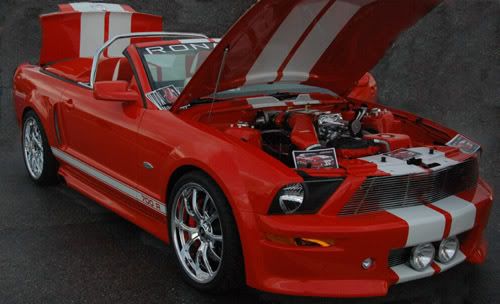
Exclusive: Ronaele Debuts their Monoceros 700hp Mustang at Daytona Turkey Run

DSC_0070-EC.jpg picture by willfusion

There seems to be plenty of Specialty Mustangs and Mustang Customizers out on the market these days, and the word coming down from Ford is that the demand is still there for more. But one Auto Customizer just raised the bar for themselves and the rest of the market. With their car 95% completed Ronaele finds the Turkey Rod Auto Show in Daytona Beach to be a great location to debut their Monoceros 700 R Mustang. What started out as one man’s wish-list based off a stock Mustang GT has turned into one mean street machine that is eager to see its time in the sun.

Monoceros was told to us to be an Indian word that stood for something mythological and unattainable; such as a Unicorn or Dragon. In the case of Ronaele’s Monoceros 700R Mustang and for the rest of us that just may be the case. And do not let that 700 R moniker fool you into thinking this is all about the badging. The Monoceros earns its 700 marking as she is dyno’d at 700-hp at the rear-wheels; because 699-hp would just not suffice.
(To learn more and to see a plethora of photos click now)


Related posts:


Related posts:


Viper converted into a police car

You know how it is, your driving along minding your own business possibly going slightly over the thirty five miles per hour speed limit, when suddenly you find that there is a police traffic cop bearing down on you, what do you do?

Well you are driving a 2000 Dodge Viper, so why not make a run for it!

This is exactly what happen, Officer Mario Marzetta of the Plainfield Police Department, heard the car coming way before he could even see it, speeding along Essington Road, passing the officer at around 127 mph, in a 35 mph zone.


viper


The driver was eventually stopped and charged with felony fleeing and eluding the police, this was after he had driven at speed through interchanges and on into an industrial park where he tried to hide from the police by parking the in a parking lot, unfortunately there are not many Dodge Vipers around with custom paint jobs, including a stars and stripes painted on the hood.

The driver was unaware of the powers of the police, they can seize any vehicle that is involved in a felony, and in this case that is exactly what the police dept has done. The Dodge Viper has now been repainted in the police dept colors and has a set of lights on the roof too.

Now do you think that speeding through Plainfield is a fun idea? Obviously not all seized vehicles are turned into police cars most are sold at auction.

Source [Suburban Chicago News]


Related posts: